
World and EU Oats Update
-Monday, February 4, 2002
This analysis featured in the February 4, 2002 issue of the HGCA's MI Prospect, Volume 4, Number 15
Key pointsOats were for many years regarded as something of a poor cousin amongst the major grains. It is, however, increasingly apparent that the long-term decline in output and use for human consumption is being reversed. Strong prices in the US in recent months reflect solid demand in niche markets in a season when supplies are short. But world oat prices are expected to fall next season so ensure you have a ready market before considering sowing oats this spring.
- World oat prices have doubled this season
- Drought in Canada has created world oat shortfall
- But return to lower prices expected next season
- Long term, oats offer niche marketing opportunities
- But determine end use before sowing
Production
World oat production has halved in the last 30 years and now stands at about 25 million tonnes. Over the same period, world production of all grains has doubled. Although oats are grown in most cereal producing regions, production is concentrated around the Baltic Sea; Sweden, Finland, Russia, Poland and Germany, in the northern US and Canada and in Australia.
From a production perspective oats compete best with other cereals in less favoured soils and short and wet growing seasons. In these areas the general long-term decline in production has been less evident. Elsewhere oats have tended to be squeezed out of crop rotations by other higher yielding cereal crops.
World oat production this year is projected to be 25.3 million tonnes, the largest crop in five years but slightly less than world consumption projected at 25.7 million tonnes, see Graph 1.
continue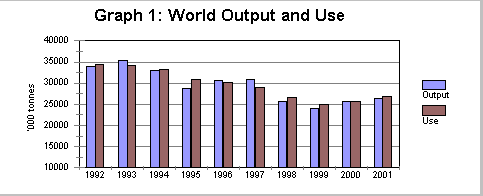
continued
Trends in EU production also suggest that the long term down ward trend in oat production has been reversed, see Graph 2. EU oat output this year is currently estimated by COCERAL at 6.2 million tonnes, about ten percent smaller than the relatively good 2000 crop. A late harvest in Sweden has resulted in about 20 percent of the crop not making milling quality due to staining. Sweden and Finland contribute about 40 percent of EU production but almost all the external trade.
continue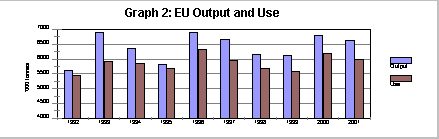
continued
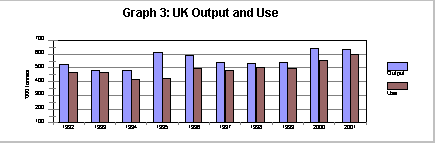
In the UK longer term oat market trends are in most respects similar to those elsewhere in the world. A slight upward trend in production and consumption is evident, see Graph 3, even if oat acreage is a tenth of what it was when horses were widely used on the land and for transport. Oat production is not very significant anywhere in the UK but relative to other cereals it tends to increases to the north and west and in the far south east where either climatic or soil conditions are more challenging. continue
continued
Demand and pricing
In its largest market, livestock feed, oats have over the years tended to trade at a discount to other feed grains such as maize, see Graph 4. In nutritional terms other feed grains have tended to prove more cost effective. But oats have two increasingly significant market niches. Traditionally they have been and continue to be a preferred feed for horses. While the era of working horses has long passed, demand from recreational horses is rising and appears to be an increasing market influence particularly in the United States. Likewise a revival in demand for oat based cereal products has occurred with a growing recognition of potential consumer health benefits in the context of high fibre and cholesterol control properties.
continue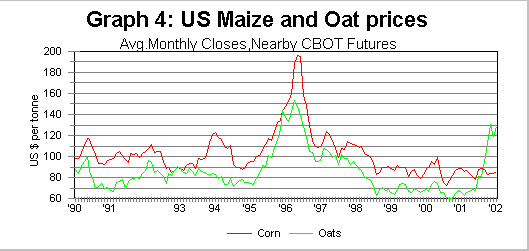
continued
In both of these markets oats have no ready substitutes in the minds of consumers and demand therefore has remained robust in the face of lower production and rising prices. This was the situation this year in the US where oat prices rose very quickly and independently from other feed grain prices when supplies of the required quality became short, Graph 3. In the past, when supplies of oats have become surplus to the needs of these two niche markets, prices have followed very closely those of general feed grains.
Trade
In terms of world trade the major exporters are Canada, Sweden and Finland with the US the dominant importer. Canada tends to supply the US food manufacturing industry situated mainly in the US Mid West. Sweden and Finland tend to supply the equine market in more southerly areas.
The drought in western Canada resulted not only in a smaller oats crop but also much of the harvest failed to meet the "heavy" requirements of the two niche markets. In Canada “light” oats, those with a low specific weight, are being discounted by as much as a third.
In recognition of the importance of oat trade to Sweden and Finland and the absence of conventional intervention support, special provision was made when they joined the EU for subsidies for their oat exports to support the market at intervention levels. This year with the substantial premiums in the US for oats, international prices have risen above EU intervention support and oats can be exported without export restitution. But with a limited accumulation of carryover stocks from last year’s good crop, the EU has not been in a position to offset the cut in Canadian supplies for the US market.
In the UK the proportion of oat usage in the human and industrial sector is relatively high at about 40 percent of total consumption. About 50 percent is used for livestock feed but very little is used in compound feed and seemingly over half of this does not enter market channels. Quite how much finds it way to the premium equine market is difficult to assess but it is likely to be significant close to centres of horse stabling.
UK oat exports normally range between 50 and 100,000 tonnes with higher levels tending to occur following larger crops. While in the past southern European destinations suggest feed usage, in recent years milling quality oats have found markets in north western Europe. Currently oats are trading at a premium to feed barley reflecting the premium on international markets but a discount to feed wheat, which this year is in relatively short supply in the UK.
Outlook
Looking ahead to next year, the premium for quality oats on international markets is unlikely to be sustained. While there is still concern about drought conditions on the Canadian Prairies, it is still three or four months until the Canadian crop is seeded and the chances are that Western Canada will not suffer a back-to-back drought year of the severity of 2001. Anything close to a normal crop in Canada either in terms of quantity or quality will ease the world oat supply situation.
Although this year is exceptional, it has shown for the first time the importance of niche markets for oats the market for which will be further supported if emerging trends in consumption continue.
While it is always important to assess market outlets before sowing any cereal crop, for oats this is particularly critical. With access to a local equestrian or milling markets and/or tricky growing conditions, oats are likely to compare well with other cereals. In other conditions they may not.
David Walker
phone: 01603 705153
top of page